
DE23 Low Differential Pressure Transmitter for Cleanrooms | Fischer
.svg)
Política de entrega (editar con el módulo de Información de seguridad y confianza para el cliente)
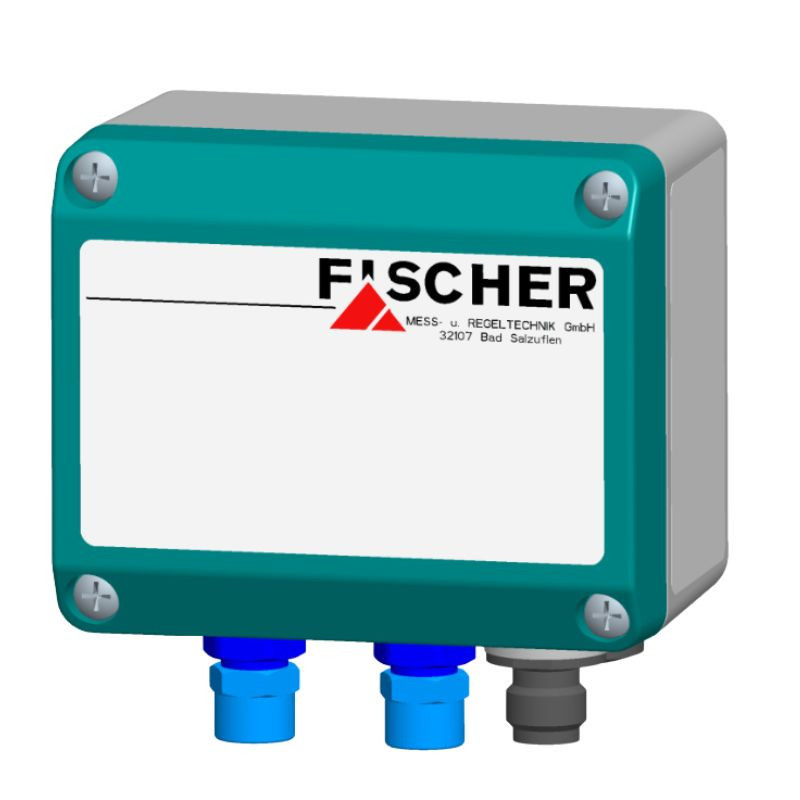
The Fischer DE23 is a low differential pressure transmitter designed for stable measurement of small positive pressures, negative pressures and pressure differences in air and neutral, non-corrosive gases.
Its measuring ranges start at 0…25 Pa and extend up to 0…1000 Pa. Bidirectional ranges are also available for applications where pressure may vary in either direction relative to the reference point.
The DE23 can be configured with one or two independent measuring channels, allowing two differential pressure points to be monitored with a single instrument. Both channels provide identical technical performance and can be supplied with their own analogue output.
The measuring principle is based on a capacitive sensing cell manufactured using silicon-glass technology. Applied pressure changes the sensor capacitance, and the integrated electronics convert this change into an industrial analogue signal of 4–20 mA or 0–10 V.
Its long-term stability, high overload resistance and maintenance-free operation make the Fischer DE23 suitable for cleanrooms, HVAC systems, building automation, filter monitoring and precision air-duct pressure measurement.
As a Fischer distributor, Garma Electrónica can assist with selecting the correct measuring range, number of channels, output signal, pneumatic connection and mounting arrangement.
The DE23 measures small pressure differences between rooms, corridors, airlocks and controlled production areas. This supports pressure-cascade monitoring designed to prevent the unwanted movement of particles and contaminants.
Its ability to measure from 25 Pa makes it suitable for low-pressure monitoring in ventilation, air-conditioning and building-automation systems. The analogue output can be connected to a PLC, controller, BMS or data-acquisition system.
Measuring the pressure drop across a filter makes it possible to detect progressive contamination. This supports condition-based maintenance and helps prevent premature replacement or excessive energy losses.
The transmitter can measure static pressure, negative pressure or differential pressure in air ducts, extraction systems and ventilation networks requiring a stable analogue signal.
The DE23 is suitable for burner underpressure measurement and furnace circulating-air control, helping maintain stable combustion, extraction and operating conditions.
The dual-channel version can monitor two filters, two rooms or two differential-pressure points with a single transmitter. This may reduce installation space, wiring and the number of devices required in the control panel.
The capacitive sensor provides stable low-pressure measurement with good repeatability and low long-term drift. Its overload-resistant and maintenance-free design is particularly suitable for continuously operating installations.
Correct configuration requires the measuring range, unidirectional or bidirectional operation, number of channels, output signal, pneumatic tube size and mounting arrangement to be defined.
Garma Electrónica provides technical support for selecting the Fischer DE23 and evaluating alternatives such as the DE80, DE90 or DE91 when the application requires a display, switching alarms, Modbus RTU, IO-Link or higher pressure ranges.
You might also like