
DA09 Differential Pressure Gauge for Liquids and Aggressive Gases | Fischer
.svg)
Política de entrega (editar con el módulo de Información de seguridad y confianza para el cliente)
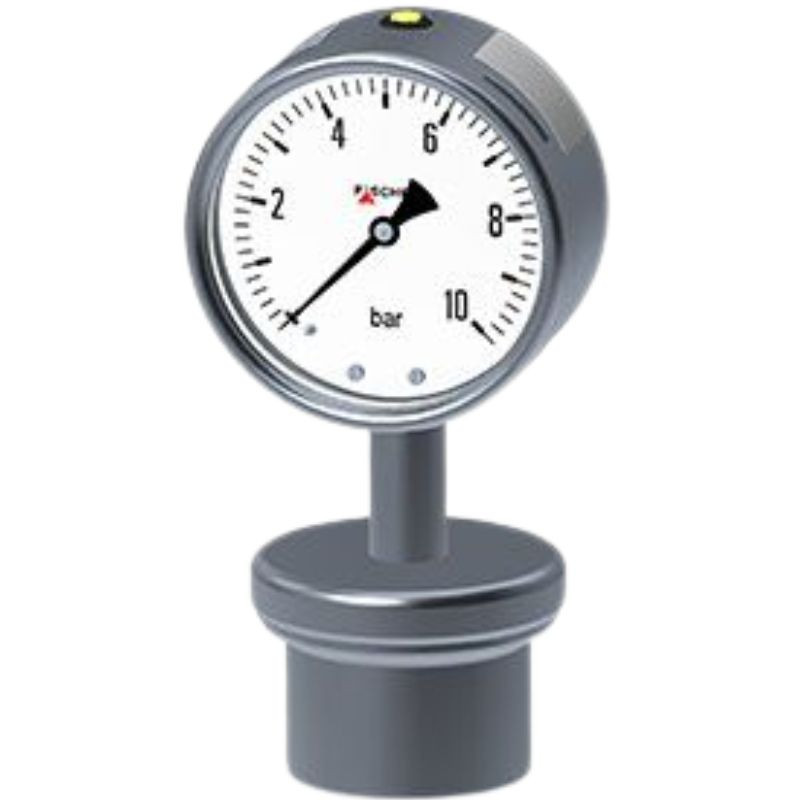
The Fischer DA09 is a mechanical differential pressure gauge designed to measure and indicate differential pressure in liquids, gases and aggressive media within demanding industrial processes.
Its stainless-steel construction and highly corrosion-resistant materials make it suitable for the chemical, petrochemical, marine, power-generation and process-engineering industries.
The DA09 product family provides measuring ranges from 0–25 mbar up to 0–25 bar, as well as compound ranges combining negative and positive pressure. Depending on the selected range, the instrument is available for PN10 or PN25 nominal pressure.
The measuring system consists of a diaphragm located between two separate pressure chambers. The difference between the pressure applied to the positive and negative sides causes axial diaphragm movement, which is mechanically transferred to the indicating pointer.
The symmetrical measuring-system design compensates for static process pressure. The instrument also withstands one-sided overload of up to ten times the upper scale value without exceeding the relevant nominal pressure.
The DA09 can be used as a local indicator without electrical power or equipped with adjustable electrical contacts to generate alarms, control signals or notifications when differential pressure reaches the defined limits.
For installations exposed to vibration, heavy pulsation or condensation, the gauge can be supplied with damping-fluid filling. Multiple process connections and mounting options are available for direct, wall or pipe installation.
As a Fischer distributor, Garma Electrónica provides technical support for selecting the correct range, nominal pressure, materials, process connections and electrical contacts.
The DA09 compares the pressure at two points in an installation and directly displays the difference. This measurement helps identify pressure losses, blockages, process variations and abnormal operating conditions.
Its stainless-steel construction and corrosion-resistant alloys make it suitable for many chemical fluids and aggressive gases, provided that material compatibility is confirmed before selection.
It can be used to monitor filters, separators, heat exchangers, pumps, reactors and other equipment in chemical and petrochemical plants.
Differential pressure upstream and downstream of a filter indicates its degree of contamination. As pressure loss increases, the gauge shows that the filter requires cleaning, maintenance or replacement.
Versions equipped with electrical contacts can automatically generate an alarm when the configured limit is reached.
The DA09 can compare pump suction and discharge pressure, helping to detect performance loss, cavitation, blockages or abnormal operating conditions.
Differential-pressure measurement across a heat exchanger helps detect fouling, deposits or internal restrictions that reduce thermal efficiency and increase energy consumption.
Its rugged stainless-steel construction, IP66 protection and optional damping-fluid filling make the DA09 suitable for marine and offshore installations exposed to humidity, saline atmospheres, vibration and rapid pressure fluctuations.
The instrument can monitor filters, pumps, cooling circuits, auxiliary systems and heat exchangers in thermal power stations, generation plants and other energy installations.
Its wide selection of ranges and process connections allows the DA09 to be integrated into industrial machinery, test benches, hydraulic units and process plants requiring rugged local indication.
Optional limit contacts allow the DA09 to operate as both an indicator and a monitoring device. Switching points can be adjusted to activate alarms, stop equipment or send signals to a control system.
In installations exposed to strong vibration or rapid pressure fluctuations, optional case filling damps pointer movement, improves readability and reduces mechanical wear.
The following application data should be defined before selecting the gauge:
Garma Electrónica provides technical support for selecting the measuring range, nominal pressure, materials, process connections, contacts and options required for each differential-pressure application.
You might also like